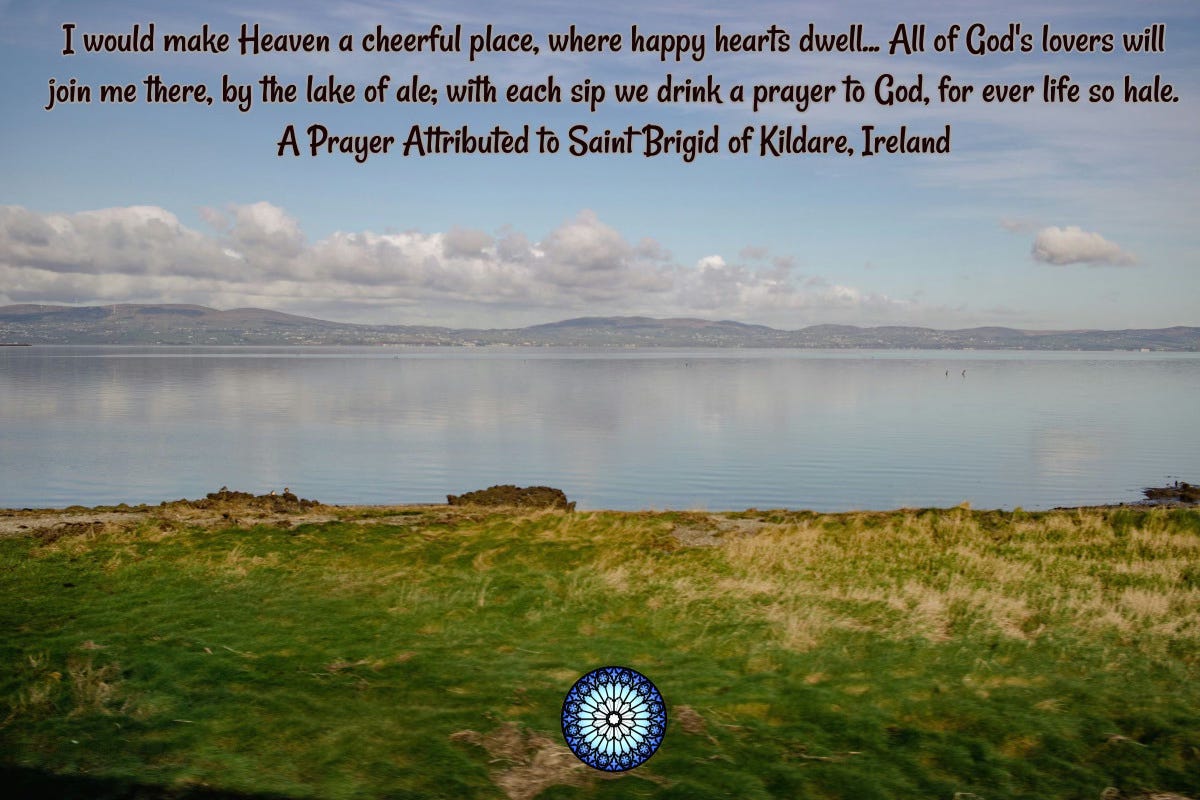
A Lake of Ale for God
Even if Brigid Didn't Pray This Prayer, It Captures Her Spirit Beautifully
In spiritual popular culture, there are prayers that get associated with certain saints or holy people, even though there’s no evidence that those prayers actually belong to the saint who gets the byline.
For example, a popular prayer that begins “Lord, make me an instrument of thy peace…” is commonly attributed to St. Francis of Assisi but the actual author remains anonymous (and the prayer first appears in print only in the year 1912). Meanwhile, a prayer that begins “Christ has no body now but yours; no hands, no feet on earth but yours...” gets credited to St. Teresa of Ávila, but that particular prayer was actually composed toward the end of the 1800s.
Finally there is a prayer, often rendered as a poem, that is credited to the Irish Saint Brigid of Kildare, although it was probably composed by an anonymous Irish monk who lived some four or five centuries after Saint Brigid. I like to think of it as a prayer written in her honor, by a monk who was trying to imagine what a prayer by Ireland’s beloved Brigid might actually be like.
Here is this medieval prayer, in a paraphrase I composed for my book An Invitation to Celtic Wisdom:
I would love to give a lake of beer to God almighty,
And may the Heavenly host imbibe there eternally.
I’d love the Heavenly host to live, and dance, and sing with me,
And whatever they want, I’d give to them, even casks of misery.
Radiant cups of love I’ll give to them, my heart more than full,
And pitchers of mercy as well, for every one to swill.
I would make Heaven a cheerful place, where happy hearts dwell,
I’d make every one satisfied—and may Jesus love me as well.
May all the hosts of heaven gather from every land and place,
The women I’ll greet with special joy, the Marys of fame and grace.
All of God’s lovers will join me there, by the lake of ale;
With each sip we drink a prayer to God, for ever life so hale.
We know so little about the historical Brigid. She may have been an early Christian nun, perhaps even a disciple of Saint Patrick; but some scholars wonder if she could have been a pagan priestess, a devotee of the goddess Brigit — or maybe even an entirely legendary figure, an attempt to make the old pre-Christian goddess more “acceptable” to Christians by recasting her as a pious Catholic saint.
I imagine we’ll never know for sure. There just isn’t enough reliable evidence from the 5th and 6th centuries, the age in which she is said to have lived.
But we do have this prayer. And perhaps in the imagination of an anonymous medieval monk, we can get a glimpse of an amazing spiritual woman, whether she is historical or legendary.
If Jesus could turn water into wine, the legend goes that Brigid could do the next best thing: turn water into beer! (I presume it would be a fifth-century precursor to Guinness.) But she was more than just a miracle-worker: she proclaimed a heaven filled with good cheer, laughter and love, a place that was unafraid of suffering but committed to transforming life’s pain into the most sacred of pleasures. In short, Brigid represents a spirituality that is playful, joyful, and just plain fun.
It’s been more than 1500 years since Brigid (if she really existed) lived. But after fifteen centuries, we mortals still have a tendency to take life (and faith) a bit too seriously. May we learn from Brigid, lift our mugs of ale to the creator of all things, and remember that joy is second only to love when it comes to the fruit of the Spirit who dwells in our very hearts.

Friends, I’m happy to announce that Spirituality and Practice will be hosting my Celtic Spirituality e-Course, running from March 23 to April 17 — a great way to journey from St. Patrick’s Day and the Spring Equinox to the ancient holy day of Beltane! The course includes 12 emails with meditations and exercises, a practice circle (which I will pop into from time to time) and a Zoom call with me on Thursday, April 9! Click here to register: https://www.spiritualityandpractice.com/ecourses/course/custom/102/celtic-spirituality-2026
Quotation source: Carl McColman An Invitation to Celtic Wisdom: A Little Guide to Mystery, Spirit, and Compassion, Kindle edition, p. 103.