A Non-Spatial Reality
Huston Smith Reminds Us Why Language Fails When It Comes to Mysticism
A lot of people get worked up in a variety of ways about how we use gender to talk about God. God the Father, Divine Mother, Mother-Father God, King, Lord, Goddess… the list goes on. Almost everyone has a pretty strong opinion about all this (and almost everyone, it seems, has at least one way of gendering the Divine they can’t stand, never mind that for someone else that very language is deeply liberating).
If we can stay calm and thoughtful as we contemplate the question of what pronouns God uses, we might remember that God is bigger than all the categories of human gender, just like the ocean is bigger than a teacup. If nothing else, this simple truth should give us the freedom and space to treat those who speak of God differently than we do with at least civility and kindness (never mind how strongly we disagree).
In his dated but significant defense of the perennial philosophy, Forgotten Truth, philosopher of religion Huston Smith (1919–2016) reminds us that almost any category of language that we use to talk about “God” inevitably gets snarled up in the disconnect between the physical structure (and limitations) of the material universe, and the infinite freedom and sovereignty of That Which We Call “God” (often for lack of a better word). He highlighted the problem of using spatial language when attempting to speak of the ultimate mystery.
No spatial, geographical terms — out there, deep within, high and lifted up, basic, fundamental, exalted, whatever — can characterize Spirit literally. But… neither can such terms be avoided. Insofar as we think, spatial images are inevitable, for thought proceeds through language, and language is forged in our encounter with the spatio-temporal world.
“Our Father in Heaven,” “The Man Upstairs,” “The Spirit Within,” “The Ground of Being.” There are many others, but even these few examples demonstrate that anything we say about God, the Spirit, the Divine, ultimately conceals as much as it reveals. Just as to call God “Father” cannot erase the feminine Divine (even though there are some patriarchal Christians who wish that it would!), to speak of the Divine “up,” “within” or even “all around” is inevitably an attempt to entrap that limitless Spirit with the leaden chains of human thought and words.
This is not a “bad” thing, of course. How can we speak of God (to each other, to ourselves, and to the God of whom we speak) if we do not use language? With language, we are tasked with using a beautiful and nuanced, but hopelessly dualistic, tool to bring us closer to that which simply is not confined or constrained by the limitations of human thought or syntax (see, I just did it again: “Bring us closer” is yet another spatial metaphor).
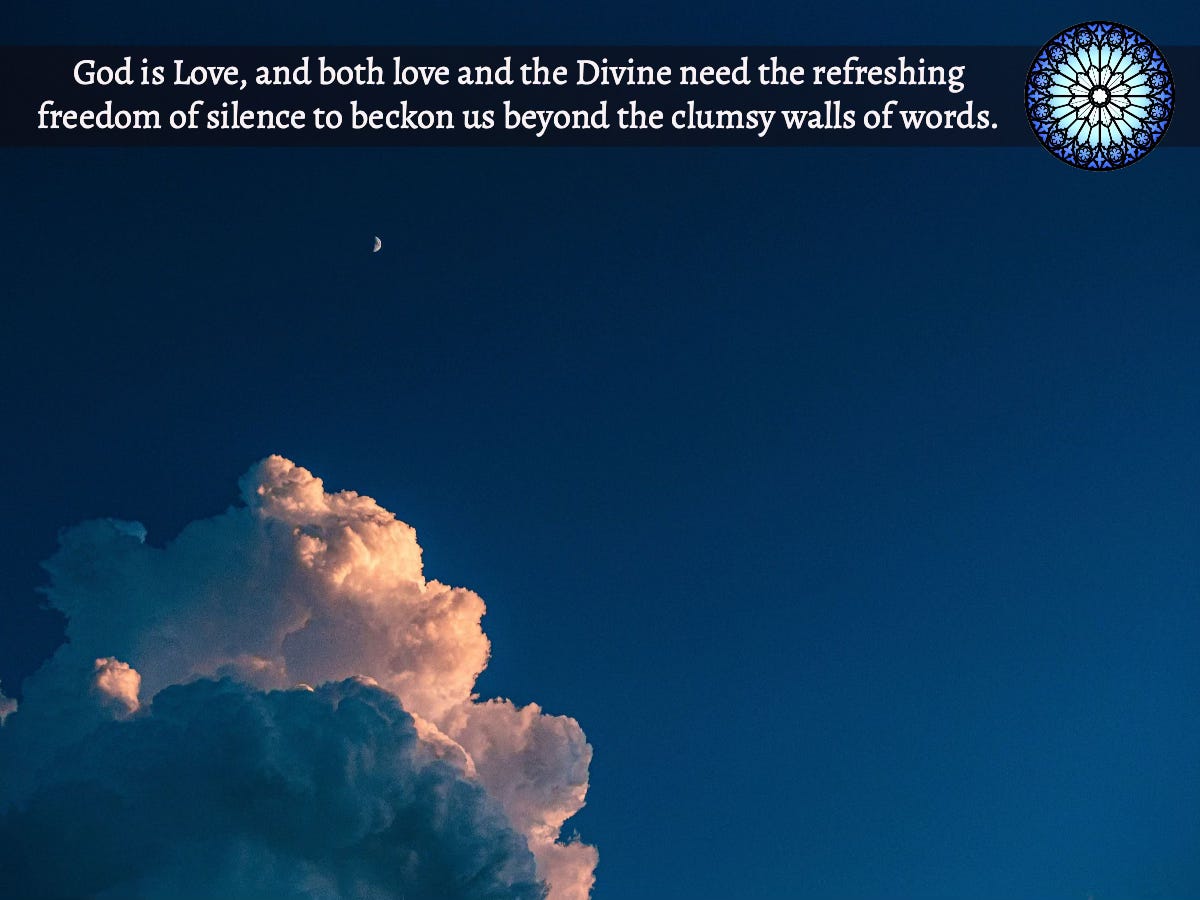
We will not stop talking about God or the Divine any more than we will cease to speak of love. But God is Love, and both love and the Divine need the refreshing freedom of silence to beckon us beyond the clumsy walls of words. May we be faithful to that liberating quiet that lives humbly between every thought and every heartbeat.
Quotation source: Huston Smith, Forgotten Truth: the Primordial Tradition (Harper & Row, 1976), p. 20.