Freedom Beyond Hatred
How safeguarding inner liberty equips us as contemplative activists
My hometown is Hampton, Virginia. I lived just three miles away from the campus of Hampton University, which at that time was known as Hampton Institute. One of the oldest and most highly regarded of historically Black colleges and universities, it was the alma mater of Booker T. Washington, who went on to found Tuskegee University in Alabama, another leading HBCU.
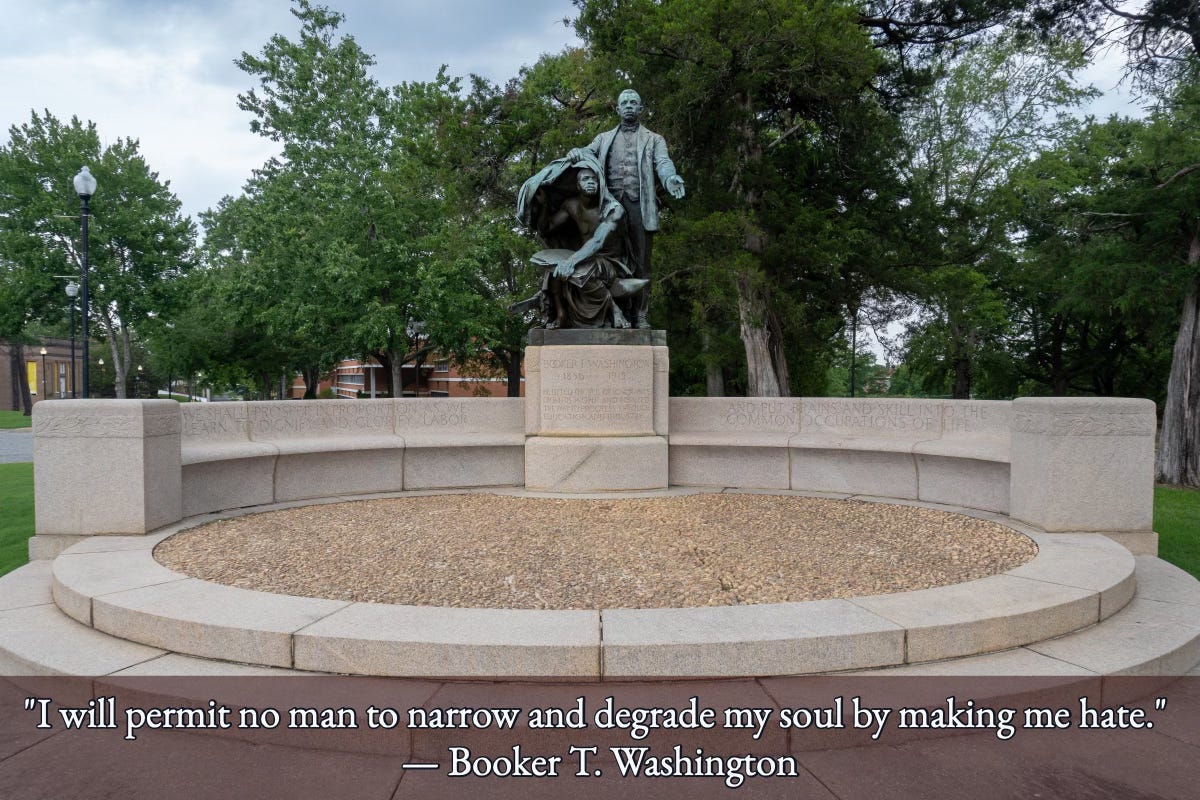
Washington is a complex figure, and significant debates surround his legacy. Yet when he published his memoir in 1901, with the sobering title Up from Slavery, he offered a sentence of striking spiritual and moral clarity. It’s a bit of wisdom he learned from Samuel Chapman Armstrong, a Union general in the Civil War who later founded Hampton Institute. As Washington described it in his book:
It is now long ago that I learned this lesson from General Armstrong, and resolved that I would permit no man, no matter what his color might be, to narrow and degrade my soul by making me hate him.
Bear in mind, he spent the first decade of his life enslaved. If anyone is justified in feeling deep anger towards those who had harmed him, it would be Booker T. Washington.
But what I believe he, and General Armstrong, and important African American leaders of the twentieth century (like Howard Thurman and Martin Luther King Jr.) all understood was that to indulge in the hatred of one’s enemies or oppressors is actually a subtle way of being defeated by them. If hatred spills over into violence, it defeats the one who hates regardless of what happens to the one who is hated; if it is kept internalized, it can cause no end of psychological and physical health issues.
So when Jesus said “Love your enemies” and the Buddha said “Only love can overcome hate,” they were offering something more than pious spiritual platitudes. They were offering us a map to freedom — perhaps only inner freedom at first, but such interior liberty is the foundation for any work we may do to set ourselves and others free externally as well.
Whether we like it or not, we live in a profoundly divided world, and the temptation to hate those we perceive as our opponents is great indeed. But only when we exercise true freedom from the inside out are we in a position to truly make the world a more just and better place.
Quotation Source: Booker T. Washington, Up from Slavery, Chapter XI.


Aloha Skye. Great post, and thank you for your willingness to bridge those gaps. Blessings 💞🙏