Seeking the Spirit of Love
The Common Good is the Heart of Community
What is the role of love in the mystical life?
In the Christian tradition, God is love — which seems to suggest that any spirituality, mystical or otherwise, that is oriented toward God (Spirit, Mystery, the Sacred, the Divine) must also be oriented toward love. The teachings of Jesus seem to be in radical alignment with this; teachings that always seem to emphasize love: love of God, love of neighbor, love of self, and even love of enemies.
But love is a big word that points to many things. The passionate love between two spouses looks a lot different from the self-giving love that characterizes a saint, a parent, or even a military hero. One of C. S. Lewis’s most famous books is called The Four Loves, based on several different Greek concepts for love: storge, philia, eros and agape — which Lewis translates as affection, friendship, eros and charity. We might also consider how words like self-sacrifice, compassion, and even patriotism can all point to different dimensions of love.
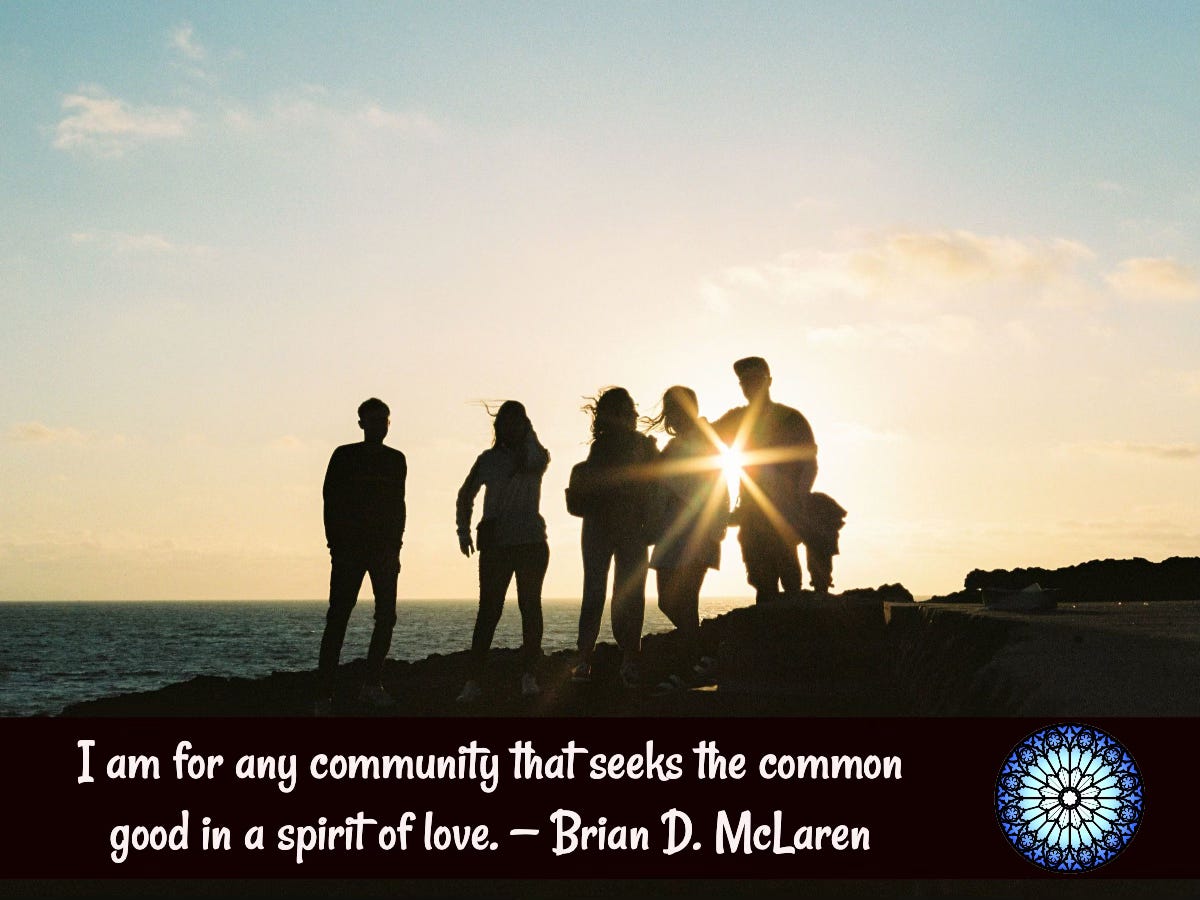
In his amazing and insightful book Faith After Doubt, Brian McLaren makes this declaration, “I am for any community that seeks the common good in a spirit of love.” Not any church, not any religious group, but any community. From a contemplative perspective, this is an important nuance. Churches and other religious groups can be deeply caring and loving communities — but they aren’t the only places where people may seek “the common good in a spirit of love.” What would it look like if we oriented our spiritual lives not toward whichever group has the right dogma or liturgies or sacraments, but rather the group that most fully embodied the spirit of love?
Hopefully, religion at its best offers precisely that type of embodiment. Unfortunately, one does not need to look very to find examples of religious groups that seem to manifest anything but the spirit of love, sad to say.
No community is perfect, of course — and when churches fail to love, perhaps they are crying to be reformed, and such a renewal must come from within. But the church that has grown cold in love might also be nearing the end of its life-cycle. To be a mystic is to be one whose dedication to love directs every aspect of life: including the choices we make about the communities we serve.
Quotation Source: Brian D. McLaren, Faith After Doubt: Why Your Beliefs Stopped Working and What to Do About It (Kindle Edition), p. 144.