Shallowness and Suffering
To Be a Contemplative Means to Dive Deep
It is so easy to fall into dualistic thinking, where light equals good and darkness equals bad. Even the Bible sometimes leans into this pattern; consider these telling verses from the Gospel of John (words spoken by Jesus):
The light has come into the world, and people loved darkness rather than light because their deeds were evil. For all who do evil hate the light and do not come to the light, so that their deeds may not be exposed. (John 3:19–20)
But is this really the best way to understand the difference between light and darkness?
Even human nature testifies that darkness is not always harmful. In the night, we sleep and rest; when we are sick, we heal. Children’s bodies grow during the darkness of night. How many babies are conceived in the dark? How many inspiring dreams, brilliant ideas, or even mystical experiences come to us in the dark?
Enter the wisdom of transpersonal psychologist and hospice worker Kathleen Dowling Singh (1946–2017). In her life-changing book The Grace in Dying, she observes that shallowness is a greater source of suffering than darkness:
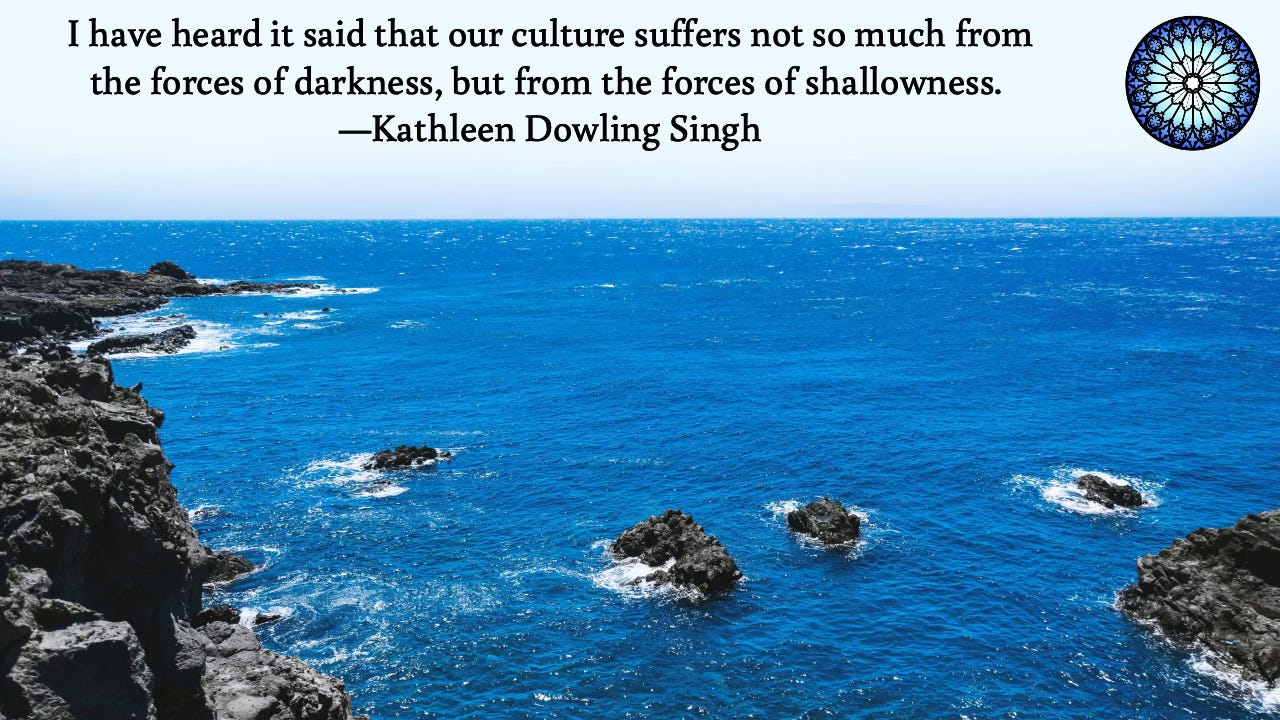
I have heard it said that our culture suffers not so much from the forces of darkness, but from the forces of shallowness.
I think this is well worth pondering. Darkness plays an essential role in the cycles of life—from day to night, from the darkness of winter to the light of summer. Shallowness, however, threatens us at any time of day or in any season. To be shallow is to ignore or avoid life’s complexity and paradoxes. A shallow person idolizes certainty or refuses to consider evidence that might contradict a preconceived view. But shallow people are not merely annoying—in groups, they undermine the careful reasoning and thoughtful analysis essential for a free society to function.
In a lighthearted movie like Shallow Hal, we equate shallowness with immaturity—the kind that mocks overweight people rather than seeking to know them. When Shallow Hal learns to see a person’s inner beauty, he discovers an entirely new way of seeing the world. Likewise, contemplative stillness invites us to go deeper—to learn to see the world and all people through the depth of compassion rather than the shallow limits of judgment.
Quotation Source: Kathleen Dowling Singh, The Grace in Dying (Kindle edition), p. 272.


thanks for this Carl.Darkness does hold secrest that I am learning to explore.