The Big Thing in the Little Thing
Mysticism Invites Holographic Seeing
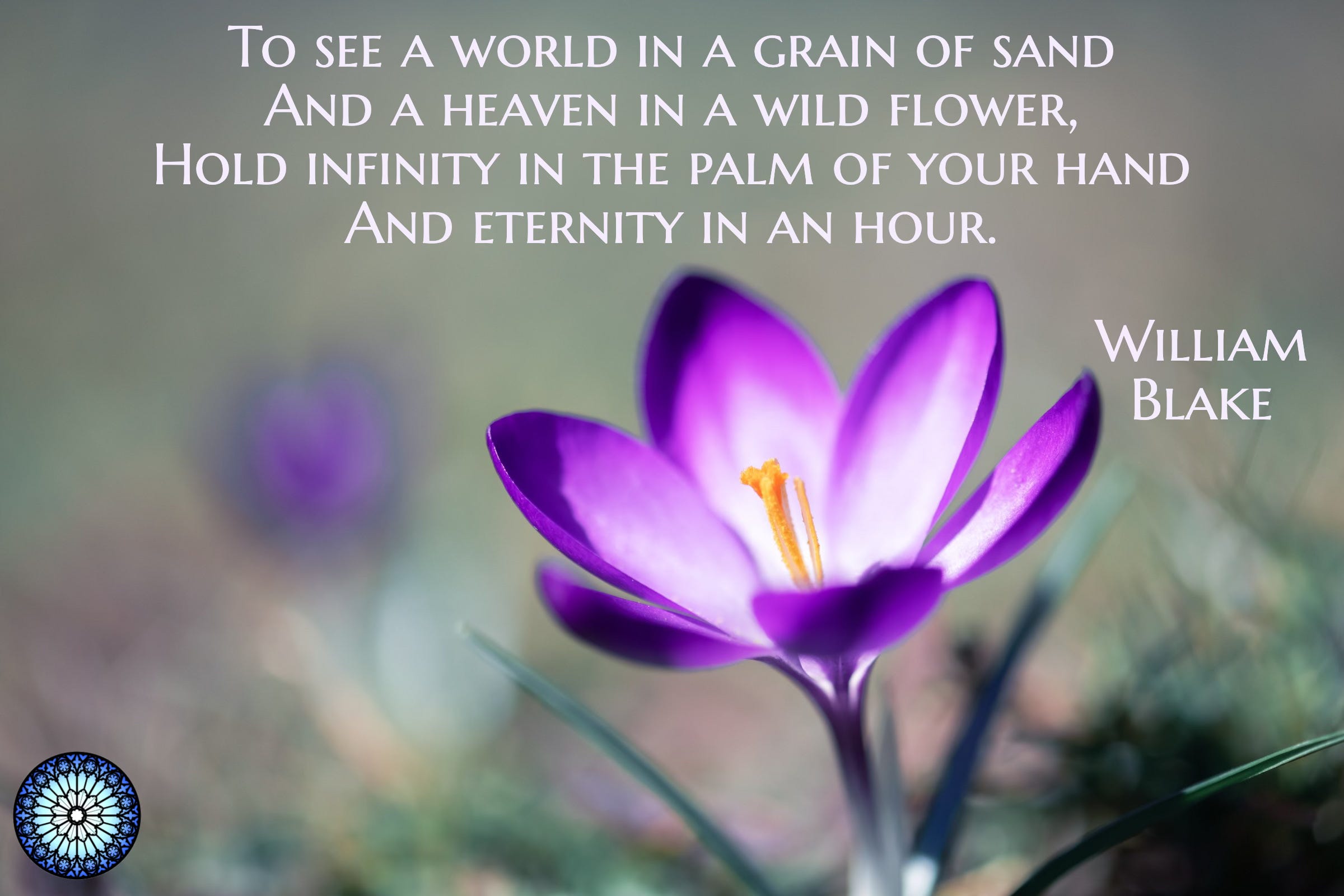
To see a world in a grain of sand
And a heaven in a wild flower,
Hold infinity in the palm of your hand
And eternity in an hour.— William Blake, Auguries of Innocence
The first time I ever recall hearing about a “mystic” was when my 11th grade English teacher used that word to describe the Romantic poet and artist William Blake (1757-1827). I remember finding the concept interesting, especially since just a year earlier (at the age of 16) I had experienced a deeply moving sense of God’s presence and love during a youth retreat. I don’t remember what Mrs. Romano, my teacher, said about mystics or mysticism, but it paved the way for me to dive deeper into this topic when, shortly after graduation, a friend gave me a copy of Evelyn Underhill’s classic book Mysticism.
As mystics go, Blake is certainly on the idiosyncratic side. A poet and an artist, his reputation in literary circles was a long time coming — for many years after his death, he was either ignored or ridiculed as eccentric and even mad. But thanks to 20th century admirers like William Butler Yeats, T.S. Eliot, Northrop Frye, and Kathleen Raine, the consensus view about Blake gradually came to a recognition of the value of his unique vision, thereby securing his place as a significant voice of mystical and esoteric spirituality.
“Auguries of Innocence,” a lengthy poem that remained unpublished until after Blake’s death, offer a series of paradoxical statements that consider the moral relationship between innocence, experience, and corruption. The first four lines are among the most recognizable quotations from Blake, and offer a beautiful, concise insight into the possibilities inherent in a nature-informed mystical sensibility:
To see… heaven… hold infinity… and eternity.
Blake seems to be viewing both time and space holographically, finding that which is universal in the tiniest of particulars. A grain of sand contains the world, a flower embodies heaven, a hand holds infinity and an hour contains eternity. Can a teacup contain the ocean? Can a skull contain the wisdom of God, or a heart contain the Spirit of God? Can a small piece of bread and a sip of wine contain the very presence of Christ?
For mystics, the answer might be simply “yes,” or an impatient “but of course,” or even more cryptic words like “it depends” or “it’s all in how you view things.” Mystics know that there is no guarantee to see the burning bush or every face shining like the sun. But the possibility is always present, and that may be enough to call us deeper and deeper into that which cannot be named or described or told — but which may be always be loved, or received through love.
If you love William Blake, Julian of Norwich, and/or Evelyn Underhill, join me on a pilgrimage in search of the “Wisdom of the English Mystics” in England, May 27-June 2, 2026. For information or to sign up, click here.
Quotation Source: William Blake, “Auguries of Innocence,” The Complete Poetry and Prose of William Blake.


Thomas Merton wrote about Blake in his Master’s thesis just before entering the monastery: -
https://merton.org/ITMS/Seasonal/24/24-1Keeler.pdf