Voluntary Silence
The silence of freely chosen attention, transformation, and even resistance: this is the silence of the mystical path.
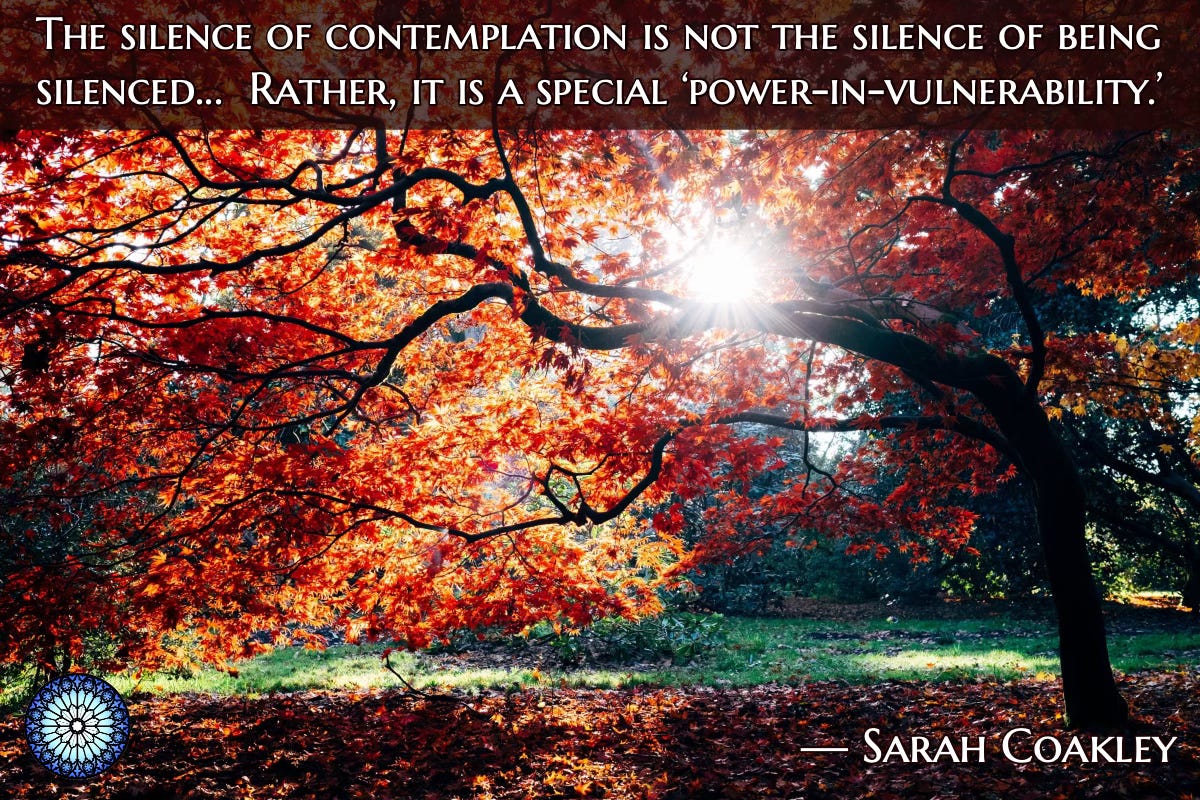
The silence of contemplation is of a particular, sui generis, form: it is not the silence of being silenced. Rather, it is the voluntary silence of attention, transformation, mysterious interconnection, and (in violent, abusive, or oppressive contexts) rightful and divinely empowered resistance: it is a special ‘power-in-vulnerability.’ — Sarah Coakley
When my friends Cassidy Hall and Kevin Johnson and I created our podcast about silence (Encountering Silence), we initially were drawn to the topic primarily out of our shared interest in contemplative life and practice. But as we went on to record over 100 episodes, each of which explored the mystery and nature of silence in some significant way, we came to see that silence takes many forms, especially in the experience of being human. And not all “silences” are necessarily helpful or spiritually nurturing.
We came to speak of something we called “toxic silence” — meaning any kind of silence that serves to undermine community and care, often by one person or group of people forcing the experience of silence on others. We may think of some commonplace examples of this kind of forced or aggressive silence; for example, a mom and dad hushing a two-year-old who has been rambunctiously screaming and laughing. To this child, the parent’s imperative to sit down and be quiet might seem foreign or odd or even somewhat threatening: “Sit down and shut up, or else.” But even if we are inclined to see this as a normal part of any childhood — after all, youngsters need to learn to balance silence and speech merely to function in society — the waters get muddier in a hurry when we think about entire groups of adults being silenced against their will. For centuries women had no voice in Western European pulpits (or courtrooms). Poor people, disabled persons, LGBTQ+ people, people of color, uneducated people… members of groups like these have often experienced barriers to finding and expressing their voice, especially in public settings. Some people grew up in homes where silence was used as a form of punishment, a disincentive used to correct behavior deemed inappropriate. Is it any wonder that people with backgrounds like those might grow up to find shared community silence to feel dangerous rather than liberating?
Anglican theologian Sarah Coakley (b. 1951) understands the difference between silence that is used to punish or control others, and the kind of silence that is the true heart of contemplation: a silence that is freely embraced, entered into for the purpose of inner transformation, and recognized as a loving gift from God. Those of us who are drawn to the contemplative life might want to take a closer look at the different ways we experience silence (or that we share silence with others); may we surrender all toxic forms of silence in trust for the deep, compassionate silence of the mystical way.
Quotation source: Sarah Coakley. God, Sexuality, and the Self: An Essay ‘On the Trinity,’ Kindle edition, pp. 84-85.