

We are all one in love.
Julian of Norwich schools us on what matters more than mystical experience.

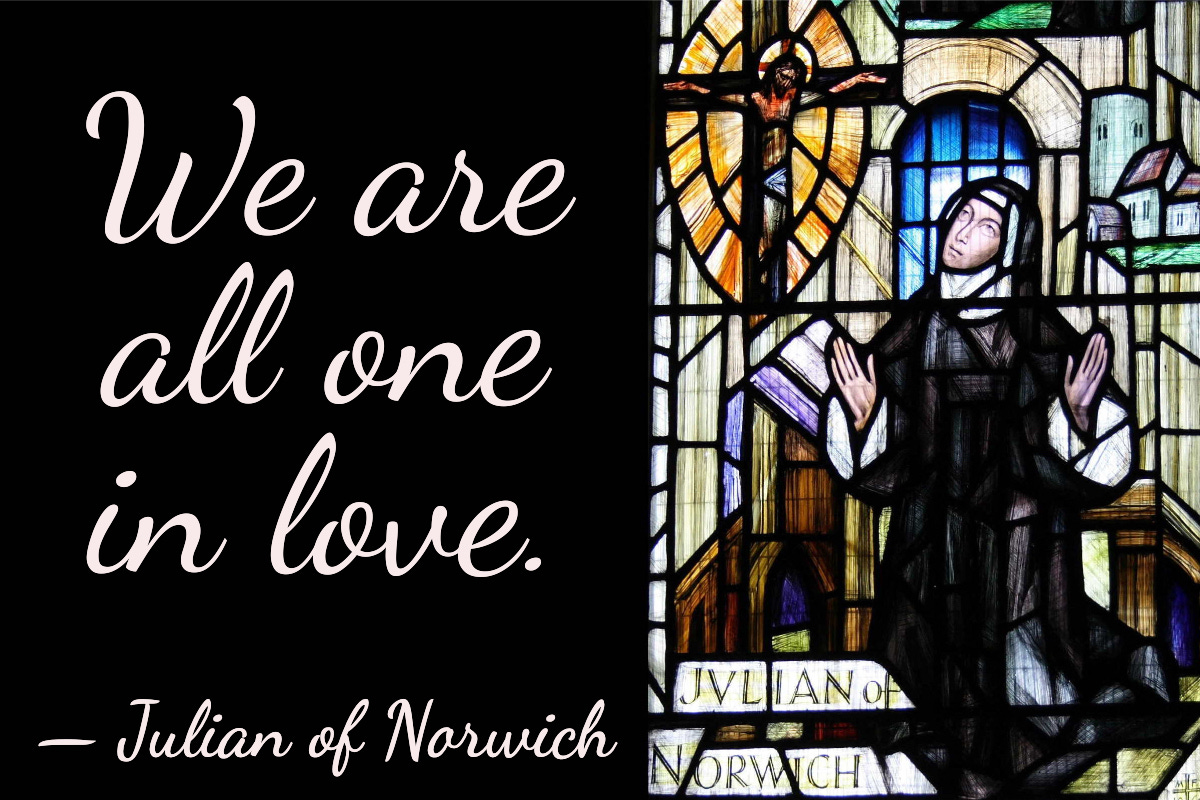
This revelation does not make me a better person. I am only better if I love God better. And if it makes you love God better, the vision is more for you than for me. I am not saying this to those of you who are wise, for you already know it well. But as for those who are simple, like me, you may draw comfort and strength from this account. We are all one in love. — Julian of Norwich1
When I used to work for the Trappist monks here in Georgia, one elderly monk in particular used to tease me and put me down, practically every chance he got. It got to the point where I just assumed he didn’t like me very much. Then, one day, I was speaking with another layperson, and this particular monk came up in the conversation. “You know he thinks the world of you,” my friend said. “Really?” I replied, incredulously. “You couldn’t tell from the way he keeps poking at me.” “That’s monastic culture,” she replied with a laugh, going on to explain that the monks had a tendency to say things about each other that, on the surface, seemed teasing or even cruel, but were actually meant to keep each other humble.
I don’t know if this was really a characteristic of monastic life in general, or simply a quirk of this particular priest. But I do know that one of the potential pitfalls of monastic culture is ego inflation — the tendency to see oneself as especially blessed or favored by God, particularly after receiving any kind of mystical experience.
After all, if you had a deep experience of union with God, wouldn’t it be all too easy to jump to the conclusion that God, therefore, must be particularly fond of you — which in turn would seem to imply that you therefore must be… special?
Recognizing how ego inflation could easily accompany any meaningful experience of God, it is illuminating to see how the medieval visionary Julian of Norwich understood her own visionary experiences — most notably in relation to other people. Julian refused to entertain any idea that her visions (“This revelation”) made her a better, or holier, person. She got it that mystical experiences are not, in themselves, the point. “I am only better if I love God better,” she bluntly states, as she points out that anyone who reads about her visions, and consequently loves God better than she does, is ultimately more of a “visionary” (mystic) than Julian herself. Eventually, this train of thought takes Julian directly to nonduality — for her line of thinking concludes, “we are all one in love.” This oneness leaves no room for any suggestion that any one of us is better than anyone else.
Mysticism, including mystical experience, is never about figuring out who is closer to God, or “better” than anyone else. On the contrary, at its purest, mystical spirituality undermines pecking orders and social hierarchies. It really makes no difference whether you are a visionary or not. We are all one in love. Therefore, the mystical life has only one real purpose: to love.

Julian of Norwich, The Showings: Uncovering the Face of the Feminine in Revelations of Divine Love, translated by Mirabai Starr (Kindle Edition), p. 23.