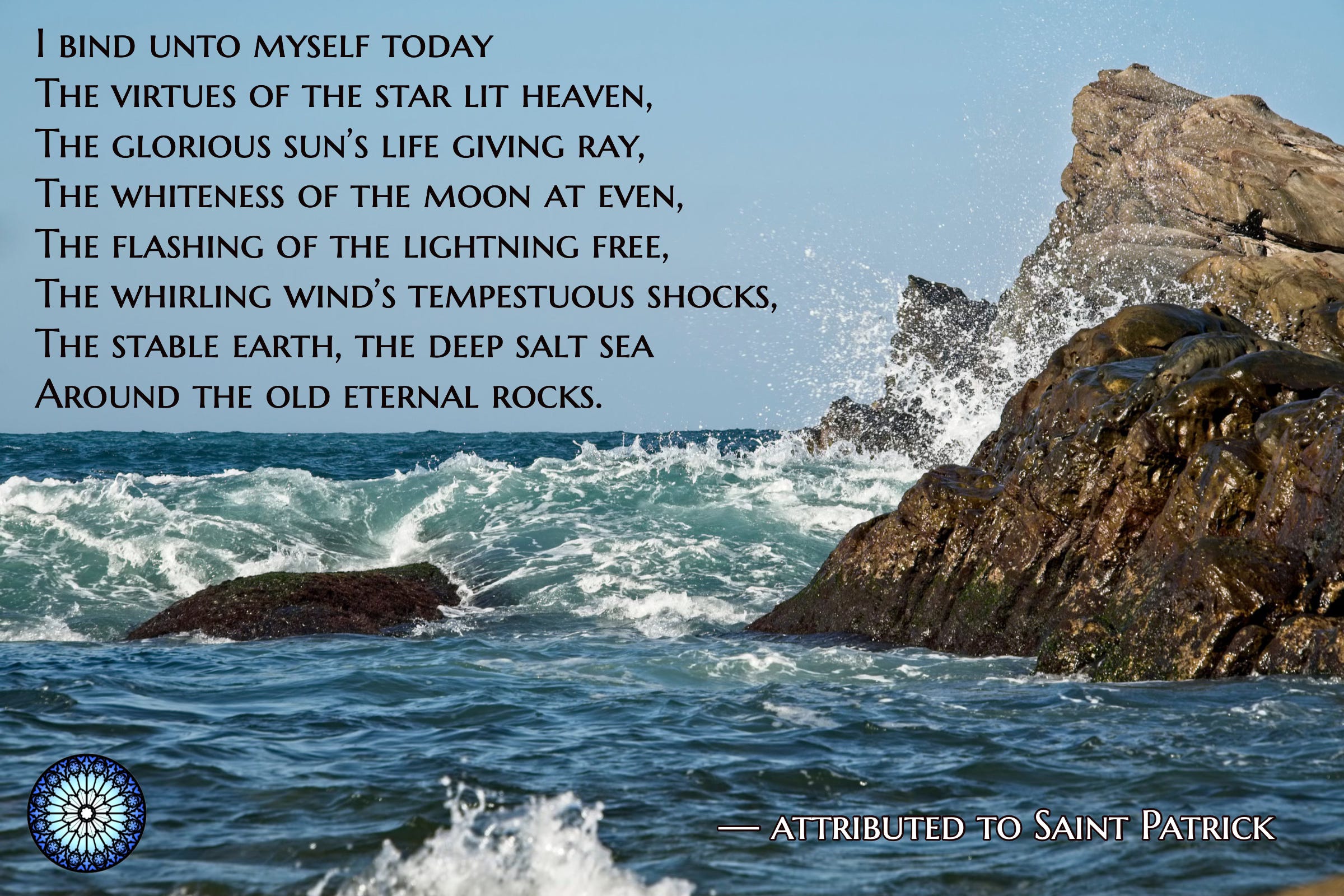
Binding Our Souls to Nature
Saint Patrick's Breastplate invites us into an ecological mysticism.
I bind unto myself today
The virtues of the star lit heaven,
The glorious sun’s life giving ray,
The whiteness of the moon at even,
The flashing of the lightning free,
The whirling wind’s tempestuous shocks,
The stable earth, the deep salt sea
Around the old eternal rocks. — attributed to Saint Patrick
Here’s another legendary prayer that is misattributed to a saint. The deeply Celtic, deeply trinitarian prayer known as St. Patrick’s Breastplate was not written by the saint himself, but was probably composed in the 9th century or thereabouts. It is associated with a folktale in which Patrick and his companions shape-shift into deer to avoid persecution from unfriendly pagans. (I’ve often wondered if, as deer, they wouldn’t be vulnerable to unfriendly hunters, but apparently that detail did not concern those who created the legend.) The prayer is called a “lorica” (Latin for “breastplate”) because it was believed to be an incantation for protection — just like armor protects a soldier going into battle.
The complete lorica is quite long, and much of it has been adapted to a popular hymn often sung on Sundays dedicated to the Holy Trinity. While scholars view this as a work of Christian literature, there has been some speculation that parts of it might even pre-date the coming of Christianity to Ireland — especially the stanza that celebrates the beauty and power of the natural world.
It has become a commonplace understanding that “Celtic Christianity” is a kind of Christianity that loves, respects, and seeks a balanced relationship with the natural world. This may be as much a product of modern romanticism as of ancient sensibilities: most of the evidence for Celtic eco-spirituality comes from poems and prayers like this one. But while some historians may argue that it’s misleading to revere the ancient Celts as nature mystics, it’s clear that the idea of Celtic love for the environment strikes a chord among many Christians and other spiritual seekers in our time. Like Santa Claus, Celtic reverence for nature may be rooted in legend, but it stands for an embodied spiritual yearning that is very real for our time.
What does it mean, or what could it mean, for contemplative seekers to “bind unto ourselves” the beauty, power, and virtues of the elements and the teeming life of the wilderness? I think it means nothing less than a commitment to foster a mutual, spiritual relationship with our environment: an encounter based not on exploitation, but on loving service and sustainable care.
Join me for a journey through the wisdom of Celtic Spirituality! My “Celtic Spirituality” e-course is sponsored by Spirituality and Practice, and begins March 23. For more information and to register: spiritualityandpractice.com/ecourses/course/custom/102/celtic-spirituality-2026
Quotation source: www.veritaspress.com/blog/st-patricks-breastplate